Why Some Neighborhoods Appreciate Faster: Key Factors Investors Watch
Two homes can sit a few miles apart, cost about the same today, and perform very differently over the next decade. One neighborhood may attract new employers, better transit, stronger retail, and rising buyer demand. Another may remain flat because jobs, access, safety, or amenities fail to improve.
That gap is what makes neighborhood analysis one of the most important parts of real estate investing. Property condition matters, but location trends often decide whether a good purchase becomes a strong long-term hold.
Neighborhood growth rarely happens by accident. It usually reflects a mix of public investment, private development, household demand, and local quality-of-life factors. Investors who learn to read those signals early can better separate short-term hype from durable value.
This article is for informational purposes only and should not be treated as financial, legal, or investment advice.

Fast-growing neighborhoods usually share a few core traits
A neighborhood appreciates faster when more people want to live there, can afford to live there, and believe the area will keep improving. That sounds simple, but the forces behind it are layered.
Some drivers are easy to see, such as a new light rail stop or a major grocery store. Others take more research, such as job growth, school enrollment trends, permitting activity, and changes in crime patterns.
The strongest markets often show several improving indicators at the same time.
Indicator investors watch | Why it matters | Signs to look for |
Economic growth | Creates jobs, income growth, and housing demand | Employer expansions, small business growth, rising wages |
Infrastructure development | Improves access and can reshape commute patterns | Transit projects, road upgrades, trails, utility improvements |
School quality | Supports household demand and resale strength | Improving ratings, strong programs, stable enrollment |
Crime rates | Affects buyer confidence, insurance, and quality of life | Multi-year declines, active neighborhood groups, better lighting |
Community amenities | Makes an area more livable and competitive | Parks, restaurants, grocery stores, libraries, recreation, walkability |
These indicators should not be reviewed in isolation. A new coffee shop does not guarantee rising property values. A new transit line may help one area while creating noise or traffic issues in another. Strong schools may support demand, but affordability limits can slow future growth.
The key is to look for convergence. When jobs, access, safety, schools, and amenities improve together, the neighborhood has a stronger case for long-term value.
Economic growth creates the demand engine
Jobs are one of the clearest drivers of housing demand. When a metro area adds employers, expands industries, or attracts higher-paying work, more households compete for available housing. That demand often reaches neighborhoods that offer relative affordability, good access, or lifestyle advantages.
For investors, economic growth matters at both the metro and neighborhood level.
At the metro level, job growth supports population growth, rent demand, and buyer confidence. At the neighborhood level, nearby employment centers can reduce commute times and make certain areas more desirable than similar neighborhoods farther away.
The strongest signals include:
Expanding industries with a long-term presence
Major employers adding local jobs
Strong small business activity
Rising household incomes
A growing base of renters who may become buyers
Limited housing supply near employment centers
A neighborhood near a strong job corridor can appreciate quickly when buyers get priced out of the most established areas. This pattern has appeared in many U.S. cities where tech, healthcare, education, logistics, entertainment, and professional services have expanded.
East Austin is a widely recognized example. For years, it offered proximity to downtown Austin at lower prices than the city’s most established central neighborhoods. As Austin’s job base expanded and demand for central locations grew, East Austin saw major reinvestment, new restaurants, infill housing, and rising buyer interest. The result was rapid price growth over time, though that growth also brought affordability pressure and displacement concerns.
A similar pattern appeared in parts of Nashville, including East Nashville and Germantown. The city’s growth in healthcare, music, tourism, and corporate relocations supported broader housing demand. Neighborhoods with character, central access, and improving amenities became more competitive as buyers looked beyond traditional high-cost areas.
Investors should still be careful. A neighborhood tied too heavily to one employer or one industry may face higher risk if that sector slows. Strong long-term potential usually comes from a diverse local economy, not a single announcement.
A practical test: ask whether the neighborhood would still attract buyers and renters if one major project were delayed. If the answer is no, the investment case may be too dependent on a single catalyst.
Infrastructure development can change the map
Infrastructure can turn an overlooked location into a practical one. Transit, roads, bike lanes, pedestrian improvements, bridges, parks, and utilities all affect how people move through a city and how they value a place.
Infrastructure development influences property values in several ways:
It reduces commute friction
It improves access to jobs, schools, and services
It signals public commitment to an area
It can encourage private development nearby
It may increase foot traffic for local businesses
Transit is one of the most visible examples. When a new rail line, bus rapid transit route, or station improves access to major job centers, nearby neighborhoods may attract more renters and buyers. The effect is strongest when the area also has walkable streets, mixed-use zoning, and limited competing supply.
Denver’s River North Art District, commonly known as RiNo, shows how infrastructure, zoning, and private development can combine. Once known more for industrial uses and warehouses, the area gained attention as galleries, breweries, apartments, and public improvements expanded. Its location near downtown and transit access helped support strong investor and resident interest.
The same broad pattern can be seen in parts of Washington, D.C., around areas that gained from transit access and redevelopment, such as the corridor around NoMa. Improved connectivity, new housing, retail, and public spaces helped change how residents and investors viewed the area.
Infrastructure can also create value outside dense urban cores. In suburban markets, a new interchange, commuter rail connection, school facility, or regional trail can shift demand toward previously overlooked areas. The impact may take years to unfold, but early signs often appear in land sales, rezoning requests, and permit activity.
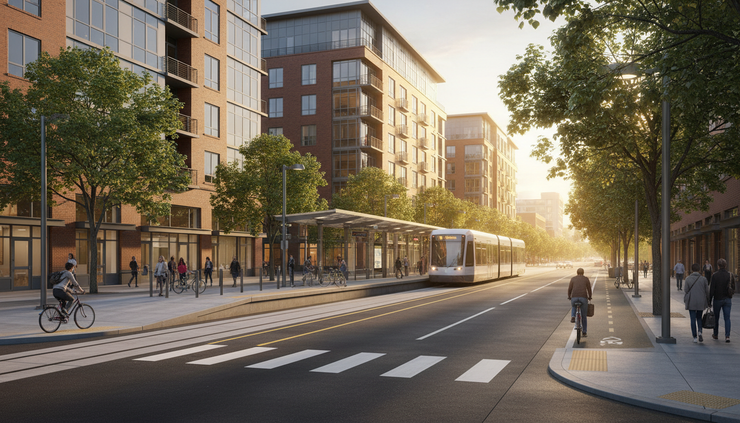
Investors should review both approved projects and funded projects. A proposed rail line is not the same as a funded line under construction. Public plans can change, budgets can shift, and timelines can stretch.
Good infrastructure research includes:
City and county capital improvement plans
Transit authority project pages
Zoning and planning commission records
Building permits and rezoning applications
Local bond measures
Utility and stormwater upgrades
The best opportunities often appear when public investment is already underway but buyer perception has not fully caught up.
Schools, safety, and amenities shape household demand
Not every neighborhood appreciates because of a major employer or transit line. Many grow because they become easier and more attractive places to live.
For owner-occupants, daily quality of life matters. For landlords, it affects tenant demand and retention. For flippers, it influences resale depth. For long-term holders, it can support both rent growth and exit value.
School quality affects more than families with children
School quality is one of the most durable demand drivers in residential real estate. Even buyers without children often pay attention to school districts because future buyers will care.
Strong or improving schools can support values by broadening the buyer pool. A neighborhood with improving school options may draw households that previously would have looked elsewhere. This can create a more stable base of demand, especially in markets where private school costs are high or commute times to better districts are long.
Investors should look beyond a single rating. Ratings can change due to methodology, demographics, testing rules, and district policies. A better review includes:
Enrollment trends
Graduation rates where relevant
Specialized programs
Parent engagement
Facility investments
District reputation
Boundary changes
Boundary changes deserve special attention. A property that currently feeds into a high-demand school may lose that assignment after a rezoning. The reverse can also happen, creating an unexpected boost.
In many suburban markets, school district lines can matter as much as city boundaries. Two homes across the street from each other can draw different levels of buyer demand if they fall into different districts.
Crime rates affect confidence and financing conditions
Safety is a sensitive topic, and it should be analyzed with care. Investors should avoid broad assumptions and use reliable data over anecdotes.
Crime trends matter because they affect resident confidence, business activity, insurance costs, and the willingness of lenders and buyers to commit to an area. A neighborhood with improving safety may attract people who previously ruled it out. A neighborhood with rising incidents may face slower buyer demand, even if it has other strengths.
The most useful analysis looks at:
Multi-year trends rather than one-month changes
Types of incidents, not just total counts
Block-by-block variation
Lighting, vacant lots, and street activity
Community policing and neighborhood programs
Business openings and public space use
Some neighborhoods improve as vacant buildings are restored, street lighting improves, and more residents use public spaces throughout the day. More activity can increase the sense of safety, which in turn draws more amenities and investment.
That feedback loop can support long-term growth, but it takes time. Investors who assume change has already happened before the data supports it may overpay.
Community amenities turn housing into a lifestyle choice
Amenities help explain why two locations with similar housing stock can trade at very different prices. People pay for convenience, identity, and daily comfort.
High-demand amenities include:
Grocery stores and farmers markets
Parks and trails
Restaurants and cafes
Libraries and community centers
Fitness and recreation options
Walkable retail
Access to hospitals and universities
Cultural venues and entertainment
Amenities do not need to be luxury-oriented. In many neighborhoods, a well-maintained park, a reliable grocery store, and safe sidewalks matter more than high-end retail.
Williamsburg in Brooklyn is one of the best-known examples of amenity-driven growth. Its transformation took many years and involved proximity to Manhattan, transit access, waterfront redevelopment, restaurants, nightlife, and a growing residential base. Investors who entered early benefited from a major shift in perception and demand, though today the area is far more mature and expensive.
Wicker Park and Logan Square in Chicago also illustrate how amenities, transit access, historic housing stock, and cultural appeal can support strong neighborhood demand. As restaurants, music venues, public transit use, and walkable retail became part of the area’s identity, buyer interest expanded well beyond local residents.
For investors, the lesson is not to chase the next trendy restaurant district. The better lesson is to track whether amenities serve the daily needs of a growing resident base. Durable amenities make a place easier to live in, not just more exciting for a weekend.

Rapid appreciation examples show how multiple forces work together
The neighborhoods that gain value quickly tend to share one trait: several positive forces arrive close together. One factor starts the shift, then others reinforce it.
East Austin, Texas
East Austin gained from proximity to downtown, the region’s expanding employment base, cultural appeal, and years of infill development. As central Austin became more expensive, buyers and renters looked east for relative value and access.
The area’s growth also shows the trade-offs of rapid change. Rising prices can displace long-time residents and alter neighborhood character. Investors should study not only price trends, but also community response, zoning debates, and affordability policy.
RiNo in Denver, Colorado
RiNo’s growth came from a blend of industrial building reuse, arts activity, transit access, breweries, apartments, and public realm improvements. Its location near downtown increased its appeal as Denver grew.
This example shows the value of physical adaptability. Warehouses, older commercial buildings, and underused parcels can become housing, retail, studios, or mixed-use space when zoning and demand align.
Williamsburg in Brooklyn, New York
Williamsburg’s long rise reflected transit access, proximity to Manhattan, waterfront redevelopment, cultural identity, and a surge in residential demand. It moved from an area with industrial roots to one of New York City’s most recognized residential and retail markets.
The key lesson is that proximity to a major job center can have powerful effects when transportation is strong and land use allows reinvestment.
East Nashville and Germantown in Nashville, Tennessee
These areas benefited from Nashville’s broader employment and population growth, along with local character, restaurants, historic housing, and central access. As the city drew more residents and visitors, neighborhoods near the urban core gained more attention.
This pattern appears often in growing Sun Belt metros. Central neighborhoods with older housing stock can become high-demand markets once buyers place more value on walkability and short commutes.
Highland Park in Los Angeles, California
Highland Park saw rising demand as buyers sought relative affordability compared with nearby high-cost neighborhoods, while still valuing access, architecture, and local amenities. Its growth reflected both spillover demand and a strong neighborhood identity.
For investors, spillover markets can offer opportunity, but timing matters. Once the price gap closes, future gains may depend more on income growth and property-level improvements.
How investors evaluate long-term potential
Short-term price spikes can come from speculation. Long-term performance usually comes from fundamentals.
The goal is to understand whether demand can keep growing without relying on hype. A useful framework is to study five questions.
Is there a real reason more people will want to live here?
A neighborhood needs a demand driver. That driver may be job access, schools, transit, affordability, amenities, or a mix of these.
A vague claim that an area is “up and coming” is not enough. Investors should identify the actual reason residents will choose it over nearby alternatives.
Strong reasons include:
Shorter commutes to growing job centers
Better schools or improving school options
More amenities within walking distance
Better housing value than adjacent neighborhoods
New infrastructure that changes access
Limited new supply in a high-demand submarket
Is the price still reasonable relative to nearby areas?
Fast appreciation can erase the discount that made the neighborhood attractive in the first place. If prices already match more established areas, the next buyer may expect the same level of schools, safety, amenities, and services.
Compare the target neighborhood to nearby alternatives. Look at price per square foot, rents, days on market, renovation quality, property taxes, insurance, and buyer profiles.
If the area is still cheaper but closing the quality gap, there may be room for growth. If it is no longer cheaper and still has weaker fundamentals, the risk profile changes.
Are rents and incomes supporting prices?
A market can rise faster than local incomes for a while, especially when outside buyers enter. That may work in supply-constrained cities, but it raises risk.
For rental property, rent growth should support the purchase price. For resale-focused investing, buyer income should support exit values. If prices depend only on the next investor paying more, the strategy becomes fragile.
This is where real estate investing requires discipline. A strong neighborhood story does not fix a weak deal structure.
Is supply limited or expanding fast?
Supply matters. A neighborhood with rising demand and limited housing inventory can see strong price pressure. A neighborhood with heavy new construction may still grow, but rent and price gains can moderate if supply catches up.
Look for:
Vacant land
Large apartment pipelines
Condo projects
Accessory dwelling unit activity
Zoning changes
Conversion of industrial parcels
Local opposition or support for development
Supply is not bad. New housing can bring residents, retail, and services. The question is whether new supply will outrun demand at the price point relevant to the investment.
Are local policies likely to help or limit investment?
Policy can shape returns. Zoning, rent regulations, short-term rental rules, permitting speed, property taxes, and historic district rules all affect strategy.
A landlord has different concerns than a fix-and-flip investor. A small multifamily buyer has different concerns than a developer. A private money lender may focus more on collateral value, exit liquidity, and whether neighborhood demand can support a refinance or sale.
Good neighborhood analysis connects policy to the actual investment plan.

A practical checklist for neighborhood research
Good research combines data with local observation. Numbers tell part of the story. Walking the area, talking with residents, and reviewing public plans can reveal what spreadsheets miss.
Use this checklist to compare neighborhoods before buying.
Market demand
Days on market compared with nearby areas
Sale-to-list price patterns
Rent growth and vacancy trends
Buyer competition for renovated homes
Demand across multiple price points
Economy and jobs
Major employment centers nearby
Commute times to job corridors
Diversity of local industries
New business openings
Small business survival and turnover
Infrastructure and planning
Funded transit or road projects
Streetscape improvements
Utility and stormwater upgrades
Rezoning requests
Building permit activity
Schools and household demand
School assignment boundaries
Program quality and reputation
Enrollment trends
Nearby childcare, parks, and recreation
Family-oriented services
Crime and safety
Multi-year crime patterns
Block-level differences
Lighting and sidewalk conditions
Vacant property activity
Community groups and public space use
Amenities and livability
Grocery access
Parks and trails
Restaurants and local services
Healthcare access
Walkability and bike access
Financial fit
Rent-to-price relationship
Renovation cost risk
Insurance and taxes
Exit options
Financing assumptions
A strong neighborhood does not automatically make a strong investment. The deal still needs the right basis, realistic costs, clear financing, and a credible exit. Appreciation can improve returns, but it should not be the only pillar of the plan.
FAQ
What is the strongest sign that a neighborhood may appreciate faster?
The strongest sign is a mix of job access, improving amenities, and constrained housing supply. One signal alone can be misleading. Several improving indicators create a stronger case.
Do new transit projects always increase property values?
No. Transit can help when it improves access to jobs and services, but the impact depends on station location, walkability, safety, land use, and local demand. Funded, active projects matter more than early proposals.
How much do school districts affect investment performance?
School quality can have a major effect on buyer demand, especially for single-family homes. Investors should review school boundaries, enrollment trends, and district plans rather than relying only on online ratings.
Are lower-crime neighborhoods always better investments?
Not always. Lower-crime areas may already be priced at a premium. Improving safety trends in a still-affordable area can sometimes offer more growth potential, but the data must support the thesis.
Should investors avoid neighborhoods that have already appreciated quickly?
Not automatically. A neighborhood that has risen fast may still have long-term strength if incomes, rents, infrastructure, and amenities support current prices. If values have run ahead of fundamentals, caution is warranted.
The best neighborhood investments are built on real demand
Neighborhood appreciation is not random. Faster-growing areas usually show clear signs of rising demand, improving access, stronger services, and better quality of life. Economic growth brings people and income. Infrastructure changes movement patterns. Schools influence household decisions. Crime trends shape confidence. Amenities turn a location into a place people actively choose.
The most attractive markets are rarely perfect at the start. They often have visible gaps, but those gaps are closing for clear reasons. That is where careful research matters.
For investors, the goal is to buy where the future is supported by evidence, not just enthusiasm. For homeowners, the same indicators can help explain why one area gains value faster than another. In both cases, the best decisions come from studying the forces that make a neighborhood more useful, more livable, and more resilient over time.


Comments